
Reviewed · BUDA CASTLE DISTRICT TOURS
Gems of the Budapest Castle District Walking Tour
Budapest’s Castle District is packed, and this walk keeps it readable. In about 2 hours 10 minutes, you hit major landmarks like Matthias Church and Fisherman’s Bastion, with explanations that connect statues, symbols, and events to what you see in front of you. What I like most is the focus on clear storytelling and frequent chances to pause for views and photos.
I also really value the human scale here. The route is tight, the guide is live, and the group stays small, with a maximum of 45 people. The one drawback to plan for is that it is a lot of stops in a short time, so you will be moving a good bit even though most stops are quick.
In This Review
- Key reasons this tour works so well
- A smart route through the Castle District, without the overwhelm
- Timing and where you start (Holy Trinity Statue, 3:00 pm)
- How the tour builds meaning from the first monuments
- Holy Trinity Statue, why the column was built
- Matthias Church, from foundations to details
- Fisherman’s Bastion: statues, legends, and Pest views
- Pope statues, the oldest building, and the National Archives wow factor
- Statue of Pope Innocent XI and the layers around it
- National Archives of Hungary: details you would miss
- WWII scars, royal regalia, and a promenade tied to the siege
- Church of Saint Mary Magdalene, coronation mantle and wartime ruins
- Arpad Toth Promenade (Setany): flags after WWII and the Buda hills view
- Dracula at the Labyrinth, then revolution and even Houdini
- Labyrinth: a cave used as a dungeon
- Statue of the Independence War and the House of Houdini
- Szent György Street, power in plain sight, then the Buda Hill Funicular
- Szent György Street: government offices and medieval ruins
- Buda Hill Funicular: second oldest, zero kilometer stone, oldest bridge
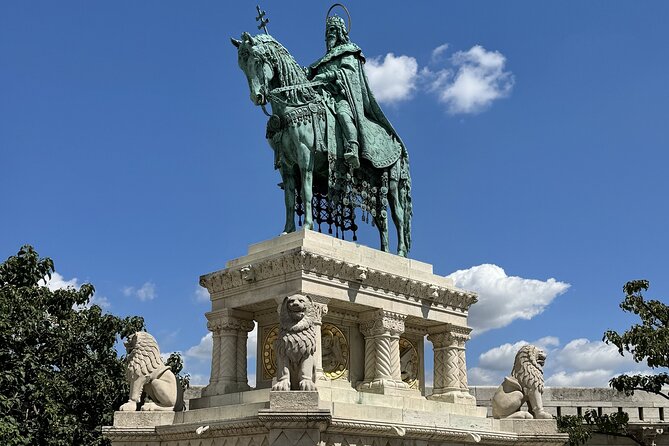
- Turul Bird, King Matthias fountain, and royal courtyards
- Turul Bird Statue: the national bird story
- Fountain of King Matthias: a romantic-tragedy angle
- Lions Court in Buda Castle: mythical facade statues
- Royal Riding Hall and the Prince Eugene statue
- Royal Riding Hall: the royal stable vibe
- Prince Eugene of Savoy: equestrian scale and Ottoman liberation
- Marian statue links to bridge stories, then Castle Garden and Varkert Bazaar
- S. Maria Mater Dei: Virgin Mary, baby Jesus, and monarch connection
- Castle Garden: spiral staircase tower and Triton fountain
- Castle Garden Bazaar (Varkert Bazar): architecture and facade statues
- What you actually get for the price
- Group size, English, and the guide factor
- Who should book this Castle District walk
- Should you book Gems of the Budapest Castle District Walking Tour?
Key reasons this tour works so well
- English guide with strong presentation, highlighted by a guide named Antel in feedback, with humor and clear explanations.
- Ticket-free sights for the route, meaning less time spent lining up and more time looking and listening.
- Photo-friendly pacing, including a dedicated stop for Fisherman’s Bastion views.
- Symbols and legends, not just names, tying things like crosses, birds, and crowns to Hungarian identity.
- A route that strings together eras, from medieval power to WWII siege memories and the 1848 revolution.
- Ends right by Castle Garden Bazaar, so you can keep wandering after the tour.
A smart route through the Castle District, without the overwhelm
The biggest win of this walking tour is how it turns a huge, confusing area into a sequence you can follow. The Castle District is full of viewpoints, courtyards, churches, and monuments, but doing it alone often means bouncing around and missing why any of it matters. This tour instead links each stop to a theme, like national symbols, royal rule, wartime scars, or revolution.
You also get a practical structure: short look, quick story, then onward. That keeps the walk moving and helps you remember what you just saw. Even if you already know Budapest basics, you still get fresh context for the statues, inscriptions, and architectural details.
And yes, it is a lot of sights. That is the trade-off. If you want a slow, sit-down tour with longer breaks inside buildings, this probably feels rushed. If you want momentum and meaning, it is a solid fit.
More Buda Castle district walks:
- Budapest: Buda Castle Cave Tour
★ 4.7 · 5,677 reviews - Budapest: Buda Castle District Vampires and Myths Night Tour
★ 4.6 · 3,830 reviews - Budapest: Buda Castle Walk with Saint Stephen’s Hall
★ 4.5 · 3,012 reviews
Timing and where you start (Holy Trinity Statue, 3:00 pm)
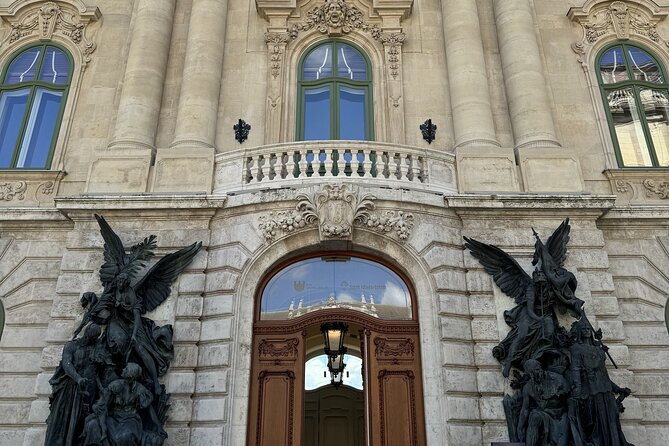
The tour starts at 3:00 pm at the Holy Trinity Statue on Szentháromság u., 1014 Hungary. It ends at Castle Garden Bazaar, at Ybl Miklós tér 2-6, 1013 Hungary, right next to Castle Garden, down by the Varkert Bazar area.
Why this start time helps: late afternoon light can make the stone and views around Buda Hill look dramatic. That matters for stops like Fisherman’s Bastion, where you are there mainly for the skyline views over Pest. If you are the type who wants photos, arrive a little early so you do not feel rushed at the first monument.
The route is also near public transportation, so it is easier to connect to your morning plans in the city.
How the tour builds meaning from the first monuments
Holy Trinity Statue, why the column was built
You begin at the Holy Trinity Statue, where the guide focuses on the construction story of the Holy Trinity column and the symbolism of the figures on it. It is the kind of stop that would look like just another statue if you did not know what to ask. Here you get a reason for the arrangement, so the column becomes a message, not just decoration.
The practical value is that it sets a tone for the rest of the walk. You start learning how the Castle District uses religious and political imagery at street level.
More Walking Tours in Budapest:
- Big Bus Budapest Hop-On Hop-Off Bus and Walking Tour
★ 3.5 · 2,206 reviews - Budapest: Buda Castle District Walking Tour
★ 4.6 · 2,108 reviews - Budapest City Landmarks Walking Tour in 2 Hours
★ 5.0 · 2,048 reviews - 3-Hour Orientation Walking Tour of Buda and Pest
★ 4.8 · 1,834 reviews
Matthias Church, from foundations to details
Next is Matthias Church, framed by a short background on the church foundation and then architectural details you can actually spot while you stand there. This is a good example of the tour staying focused: you do not wander for ages, but you also do not leave without something concrete to notice.
If you like architecture, even in quick bites, this stop delivers. If you are less into buildings and more into stories, it still helps you anchor the area in real time periods.
Fisherman’s Bastion: statues, legends, and Pest views
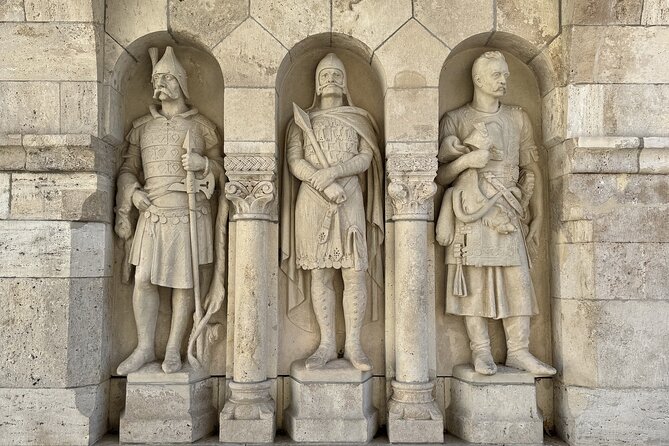
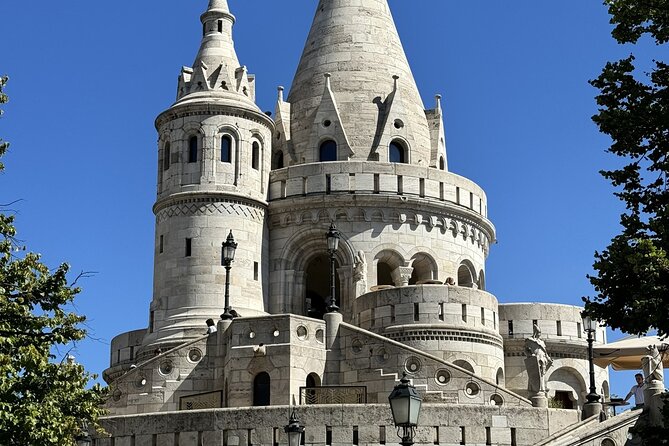
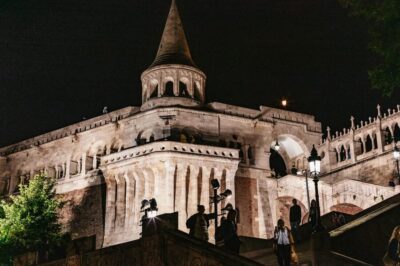
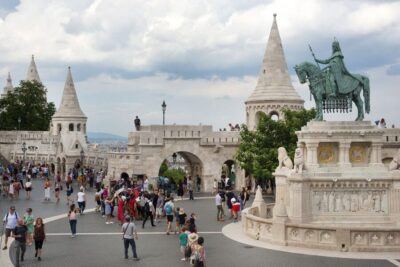
At Fisherman’s Bastion, the pace slows just enough to make it worthwhile. You get time for interesting statues, plus a story about the relation of the double cross and the Hungarians. There are also intriguing legends, and the stop includes a short photo break.
This is the moment in the tour where Budapest really feels like Budapest. The panoramic Pest views do a lot of heavy lifting here. The guide’s job is to prevent that view from turning into a mindless photo shoot by giving you context, so you look at the skyline with a better grasp of what you are seeing.
One consideration: the viewpoint areas can be crowded at peak times. Since the tour starts at 3:00 pm, it often hits that shoulder period, but you still might want to move with purpose and keep your camera ready.
Pope statues, the oldest building, and the National Archives wow factor
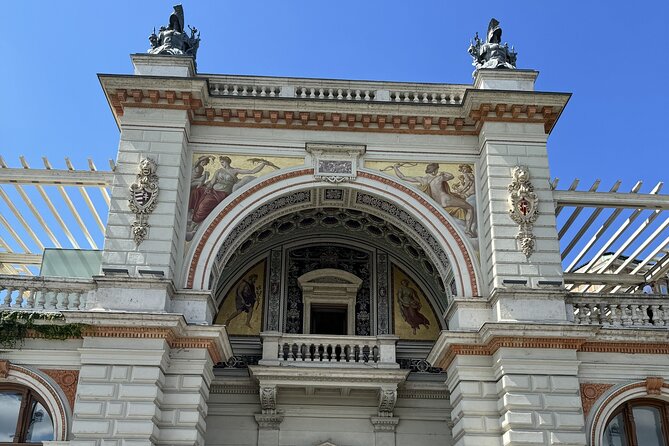
Statue of Pope Innocent XI and the layers around it
The stop at the Statue of Pope Innocent XI brings a twist: you also hear about Pope Sylvester II and the coronation statue of King Matthias. In other words, the tour uses one spot to show how religious authority and royal power overlap in the Castle District’s public art.
Even if you only catch parts while walking, this is the kind of stop that gives you a vocabulary for what you are seeing. It trains you to notice when a statue is about legitimacy, not just reverence.
National Archives of Hungary: details you would miss
Then you reach the National Archives of Hungary, described in the tour as full of architectural wonders. You also get a look at the Vienna gate and Golden signatures by Uri Street, plus statues nearby and the tales tied to them.
This is one of the best stops for people who enjoy reading facades. Archives buildings can feel dry if you rush past them, but here they become storyboards.
If you are sensitive to fast movement, this is a place to pay close attention, because architectural details tend to go by quickly when you are walking. A guide helps you pick out what is actually worth lingering on.
WWII scars, royal regalia, and a promenade tied to the siege
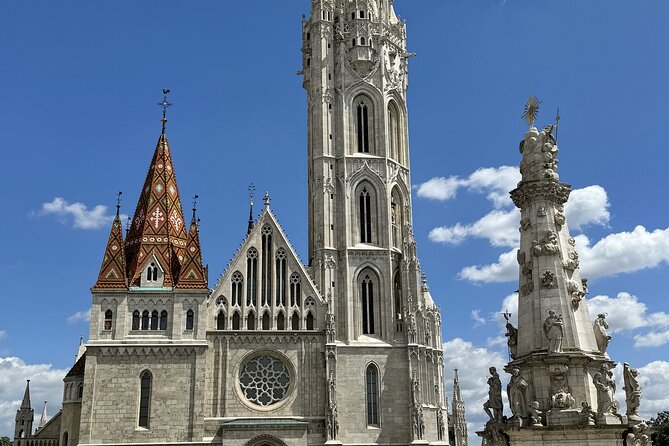
Church of Saint Mary Magdalene, coronation mantle and wartime ruins
The Church of Saint Mary Magdalene stop focuses on the monument of the coronation mantle of the Hungarian kings, plus ruins from WWII. This combination is important. It ties monarchy and ceremony to the reality that the city took real damage and then rebuilt.
If you prefer history that connects to visible remnants, this part works. It is not just dates, it is material you can point at.
Arpad Toth Promenade (Setany): flags after WWII and the Buda hills view
Next is the Arpad Toth Promenade, also called Setany. Here you learn about the first flag after WWII, a row of cannons, and you get views of the Buda hills. There is also a statue of a Szekely knight and a brief history of WWII and the siege of Budapest.
This stop feels like a bridge between the “heroic” stories and the reality of conflict. You get symbols, then you get their context. That makes the promenade more than a walkway.
And yes, it is a good pause for photos, especially with the hills showing up behind the area.
Dracula at the Labyrinth, then revolution and even Houdini
Labyrinth: a cave used as a dungeon
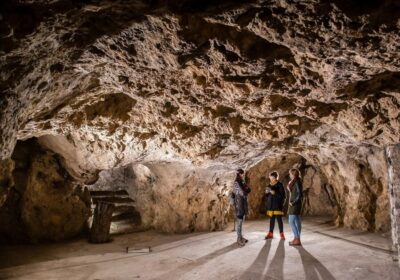
The tour then moves to the Labyrinth, described as a natural cave used as a dungeon. This is where a legend shows up again, this time linked to the Dracula story and Vlad the Impaler.
This stop is for you if you like folklore mixed with physical place. You are standing somewhere that already feels like it belongs to a tale, and the guide gives you a reason to connect the name to the site.
Statue of the Independence War and the House of Houdini
After that, you get the Statue of Independence War, with background tied to the Hungarian revolution of 1848. The guide connects the symbolisms of the statues to the original war, which helps you avoid treating monuments like abstract art.
Right near the area you also get the mention of the House of Houdini, which adds a fun offbeat note to the political theme. It is a good moment to break the heaviness of revolution with something unexpected.
Szent György Street, power in plain sight, then the Buda Hill Funicular
Szent György Street: government offices and medieval ruins
Szent György Street is framed around offices of the president and prime ministers, along with ruins of medieval castles and secret stories. You end up looking at a part of the city that is both contemporary and layered.
This is where your brain benefits from having the guide. Without context, government buildings can feel like a barrier. With context, they become part of the story of who held control in different centuries.
Buda Hill Funicular: second oldest, zero kilometer stone, oldest bridge
Then comes the Buda Hill Funicular stop, described as the second oldest funicular. You also see the zero kilometer stone and hear about the oldest bridge of Hungary.
This is one of those practical-sight stops that helps you understand how people actually move through the district. It is not just a scenic walk, it is a place with transit roots and geographic markers that tell you where you are in the city’s layout.
Turul Bird, King Matthias fountain, and royal courtyards
Turul Bird Statue: the national bird story
The Turul Bird Statue is focused on the national bird of Hungary and the background behind the bird. You also get the storyline of the naming of the Hungarians.
This stop is short, but it matters. National symbols can look like pure design until you learn why they were chosen, then suddenly they feel purposeful.
Fountain of King Matthias: a romantic-tragedy angle
Next is the Fountain of King Matthias, described as the prettiest fountain of Budapest, paired with a romantic-tragedy story. Even if you are not usually a fountain person, the story lens makes you look more carefully at the setting.
Lions Court in Buda Castle: mythical facade statues
You then reach the Lions Court, part of the Buda Castle complex. The emphasis here is the courtyard and the mythical statues on the facade, with explanations of what you are seeing.
This is a great stop for close visual attention. Facades reward you when someone points out which figures to look for and what they represent.
Royal Riding Hall and the Prince Eugene statue
Royal Riding Hall: the royal stable vibe
The Royal Riding Hall stop is about the royal Hungarian stable and includes interesting local trends. It is brief, but it gives your walk a different angle from politics and religion. You see power as routine and performance, not only monuments.
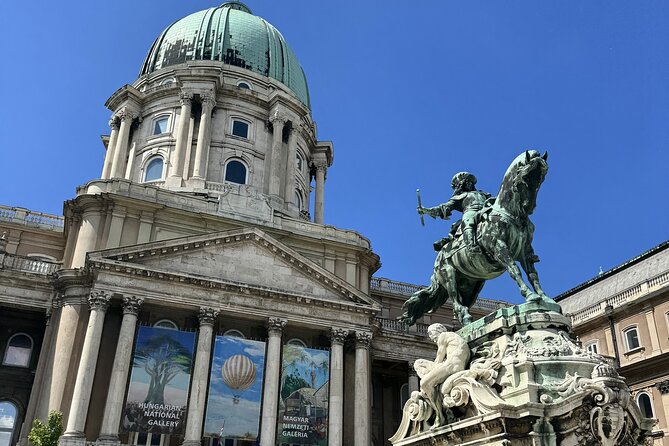
Prince Eugene of Savoy: equestrian scale and Ottoman liberation
Finally in this royal cluster, you get Prince Eugene of Savoy’s equestrian statue, described as the biggest statue in the castle district. You learn that he is presented as a liberator of the Hungarians from the Ottomans, plus fun facts.
This is the stop that feels cinematic. Even if you do not know every historical detail, standing near a large equestrian monument makes the story feel immediate.
Marian statue links to bridge stories, then Castle Garden and Varkert Bazaar
S. Maria Mater Dei: Virgin Mary, baby Jesus, and monarch connection
The S. Maria Mater Dei stop highlights a statue of the Virgin Mother Mary and baby Jesus. The tour also connects the bridges of Budapest to Hungarian monarchs, tying the religious symbol to broader national symbolism.
If you like when a tour connects distant parts of a city, this is your kind of detail. It pulls Budapest’s geography into the narrative.
Castle Garden: spiral staircase tower and Triton fountain
Then you move into Castle Garden, described as the garden of the castle. The tour mentions a spiral staircase tower and the Triton fountain.
This is a good spot to loosen your pace slightly. After many monuments, a garden and fountain setting lets your eyes rest while still keeping your momentum.
Castle Garden Bazaar (Varkert Bazar): architecture and facade statues
You finish at Castle Garden Bazaar, also associated with the varkert Bazar architecture and statues along the facade. Since the ending point is right by the castle hill area, you can decide on the next step immediately, whether that means more exploring or heading back into the city.
What you actually get for the price
The listed price is $3.61 per person, and it includes a live guide. That is the part that feels most surprising, because you are paying for human storytelling across a route packed with landmark-level stops.
To judge value, look at how the tour works as a package:
- You get an English-speaking guide for a concentrated stretch.
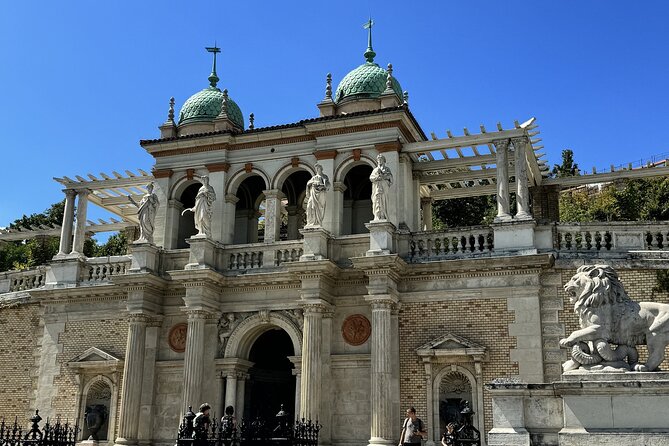
- You get a sequence of stops where admission is listed as free for each stop.
- You get enough pacing for photo breaks at key viewpoints.
Are there costs you should expect? Tips are not included. So if you plan to tip, budget for it. Also, because most stops are quick, you are not paying for museum time. You are paying for interpretation and direction.
If you are traveling on a tight budget or you hate wasting time hunting for what to see, this price-to-effort ratio feels hard to beat.
Group size, English, and the guide factor
The tour offers English and includes a live guide. The group maximum is 45 travelers, and it uses a mobile ticket.
In the feedback tied to guide experiences, a standout name comes up: Antel. The most repeated praise is about strong English, clear presentation, and humor that makes the stories easier to remember. If you get a guide with that style, you will likely feel like the city is talking back to you instead of just passing by.
Smaller groups matter because Budapest’s viewpoints can get tight. Even with 45 people, the route is designed around short stops, so you do not lose the whole group while someone catches a photo.
Who should book this Castle District walk
This tour suits you best if:
- You want a fast, organized route through the Castle District.
- You enjoy symbol stories, legends, and connecting monuments to real events.
- You want an English guide to point out what is easy to miss.
It may not suit you if:
- You hate walking and prefer fewer stops.
- You want deep museum time or long indoor visits.
- You are looking for a mostly sit-and-watch experience.
Should you book Gems of the Budapest Castle District Walking Tour?
If your goal is to understand the Castle District quickly, with a guide turning statues and architecture into meaningful context, I think it is a smart buy. The timing, the mobile ticket, and the included English live guidance make it easy to commit without overplanning. Add the photo-friendly pauses and the fact that the route is packed with free-to-view stops, and it becomes a strong first pass through the area.
Book it if you are going in good weather, because the experience notes that it needs good weather. If you are visiting when rain is likely, keep your plan flexible.
If you want a fast, guided “get your bearings fast” walk with real stories tied to Hungarian identity, this one earns its reputation.
Latest to land in Budapest
- Visegrád Hike & Castle Tour with Ferry from Budapest★ 4.6 · 3 reviews
- Budapest: Vacation Photographer to collect great memories★ 5.0 · 49 reviews
- Trash Art Museum: Hungary’s First Scrap Metal Exhibition★ 4.3 · 72 reviews
- True Crime Walking Tour in the Buda Castle district★ 5.0 · 26 reviews
- Budapest: 3-Hour Trabant Sightseeing Tour★ 4.7 · 28 reviews
- Audio visual multi-sensory chefs journey dinner experience★ 5.0 · 3 reviews
- Private Walking Tour in The Jewish District Budapest★ 4.5 · 16 reviews
- Private Szentendre and Vac Tour from Budapest with Transport★ 5.0 · 3 reviews
Buda Castle District Tours, compared.
Buda Castle District Vampires and Myths Night Tour
Read our review →

Buda Castle District Dark History, Legends and Vampire Night Tour
Read our review →
Buda Castle District Walking Tour with a Historian
Read our review →

Browse the lists this tour appears in