
Reviewed · BUDA CASTLE DISTRICT TOURS
Buda Castle Tour: History and Architecture
Budapest can feel like two cities at once.
This Castle District walk turns Buda Castle into a timeline, one street and ruin at a time. You cover royal power, merchant life, religious change, and even 20th-century debates about rebuilding on top of the past.
Two things I really like: the way the tour explains architecture as evidence of power shifts, and the human scale of an intimate group of up to 12.
One thing to consider: it is a long, standing-and-walking style tour (about 3 hours 30 minutes), and it is not suitable for limited mobility.
In This Review
- Key reasons this Buda Castle District tour is worth your time
- Royal Palace layers: why the walk beats the usual castle sightseeing
- Sigismund’s medieval church foundations: the quiet clue in the courtyard
- Tárnok Street and Úri Street: where medieval Buda lived, traded, and built
- Saint Mary Magdalene tower: resilience written in stone
- Országház Street and the finance building: multilingual Buda and modern controversy
- Matthias Church area and Fisherman’s Bastion: iconic sights, with the right limits
- Fortuna Street to Becsi Kapu Square: printers, inns, and a medieval meeting point
- National Archives and the 1686 siege story: power leaves paperwork and bullet holes
- Medieval Jewish quarter: excavations, worship spaces, and what is included
- Reused medieval walls and the Dominican ruins near the Hilton
- Price, group size, and what you truly get for $43.25
- The kind of guide you want: what the best feedback says
- Who should book this Buda Castle District walking tour
- Should you book this Buda Castle Tour?
- FAQ
- What is the duration of the Buda Castle Tour?
- How much does the tour cost?
- Is the tour offered in English?
- Is the Royal Palace interior included?
- Is Matthias Church interior admission included?
- Is Fisherman’s Bastion upper terrace access included?
- What is included with the Jewish quarter stops?
- Where does the tour start and end?
Key reasons this Buda Castle District tour is worth your time
- Royal Palace as a living timeline, built, destroyed, and rebuilt in different styles
- Medieval streets you can actually feel, like Tárnok Street and Úri Street, not just viewpoints
- A rare included interior, the excavated medieval Jewish prayer house (closed Sat and Mon)
- Siege-of-1686 storytelling on the walls, with a memorial marking where the city fell
- Layered reuse of ruins, including medieval stonework folded into later Baroque and hotel-era buildings
- You skip the ticketed terraces, so you can spend the time walking the story, not waiting in lines
Royal Palace layers: why the walk beats the usual castle sightseeing
Most people think Buda Castle is one building. This tour makes the point that it is really a patchwork of eras. You’ll spend time at the Royal Palace complex and get the big idea fast: over centuries, it was built up, torn down, and rebuilt again, usually after major political fights.
What I like about this approach is that it teaches you how to read buildings. Gothic, Baroque, and Neoclassical touches stop being trivia and start being clues about who had power and what they wanted to look like. The tour keeps circling back to that theme, so by the time you’re walking below the palace walls, you understand why the stones look the way they do.
One practical note: the Royal Palace interior is not included. You’re looking at the palace story from outside and from nearby archaeological points. If you also want museum-style rooms and exhibits, you can add the interior visit later on your own.
More Buda Castle district walks:
- Budapest: Buda Castle Cave Tour
★ 4.7 · 5,677 reviews - Budapest: Buda Castle District Vampires and Myths Night Tour
★ 4.6 · 3,830 reviews - Budapest: Buda Castle Walk with Saint Stephen’s Hall
★ 4.5 · 3,012 reviews
Sigismund’s medieval church foundations: the quiet clue in the courtyard
Right away, the tour drops you from the headline landmark down to something easy to miss if you’re on your own: the remains of the medieval Sigismund Church. During the early 15th century, King Sigismund expanded the palace and created a Gothic royal chapel component as part of the complex.
The foundations you see today are short on spectacle, but great for meaning. They show how royal building projects weren’t just about ceremonies upstairs. They were also about reshaping the everyday space around power, down in the courtyards.
This is one of those stops where a good guide matters. You get context for why the traces matter, not just that they exist.
Tárnok Street and Úri Street: where medieval Buda lived, traded, and built
Then you step into the Castle District’s “working city” layer. Tárnok Street was the main commercial street of the former burgher town below the royal court. It’s a cobbled lane, and the charm comes from the fact that it still feels like a street you could shop on, not a theme park corridor.
Here, you’ll learn how merchants stored and displayed goods and how everyday commerce shaped life for Buda’s burghers. You also visit multiple authentic buildings that have survived fire, siege, and centuries of urban change. The point is not that every stone is perfectly preserved. The point is that you’re looking at medieval foundations that stayed in play while the city kept rebuilding around them.
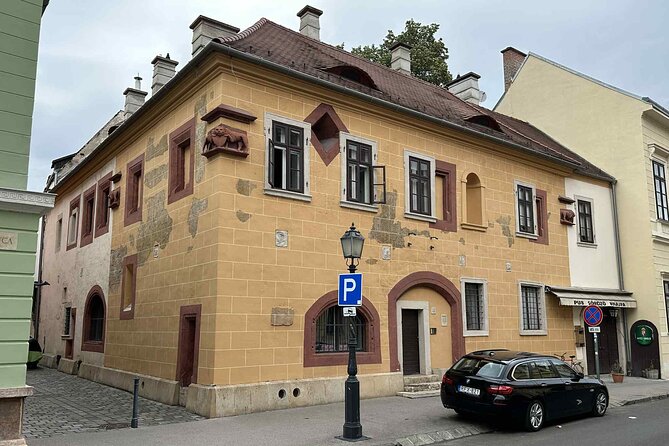
Next comes Úri Street, the noble residential quarter. If Tárnok Street is commerce, Úri Street is status. You’ll notice remnants of aristocratic palaces and residential houses built on 14th to 15th century foundations. One highlight is the collection of medieval gateways and ornate entrances, with arches that once welcomed merchants, craftsmen, and travelers.
If you like architecture, these two streets are where it all clicks. You can start connecting facade details to social function: who lived here, who passed through, and why the entrances were designed to impress.
Saint Mary Magdalene tower: resilience written in stone
At the Church of Saint Mary Magdalene, you focus on a site with a long, complicated fate. This church was built on the area of the earliest church on Castle Hill, and the foundations date back to the 13th century. It also once served as the main parish for the Hungarian-speaking population in the area historically known as Szombathely.
You get the weight of two historical blows: partial destruction during the siege of Buda in 1686, and then later demolition in the 1950s under Hungary’s communist regime. The survival story matters here. The medieval tower is what remains, and it’s preserved thanks to archaeologists and preservationists.
From a travel standpoint, I love this stop because it changes the mood. It’s not just about style. It’s about memory and what a country chooses to save, even after politics shifts.
Note: the tour does not include entrance to the church interior. You’re mainly there to see and understand the structure and its historical importance.
More Art Nouveau walks:
- Art Nouveau Tour in Budapest: 3-Hour Private Tour
★ 4.6 · 21 reviews - Private Art Nouveau Tour Budapest
★ 5.0 · 21 reviews - Art Nouveau Treasures of Budapest – Exclusive Private Tour
★ 5.0 · 18 reviews - Budapest Art Nouveau Walking Tour
★ 5.0 · 17 reviews
Országház Street and the finance building: multilingual Buda and modern controversy
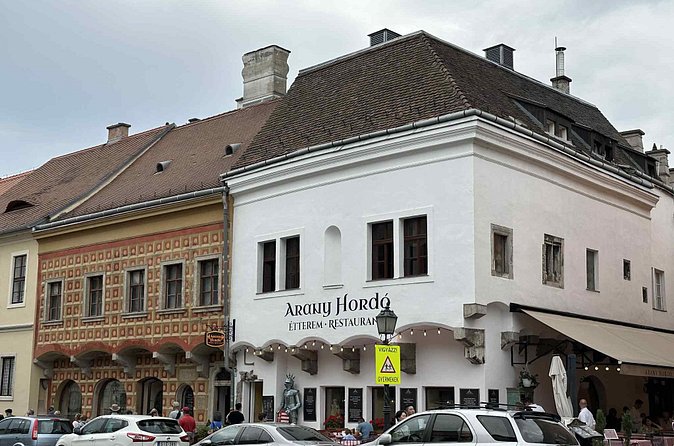
The next section shifts from churches and royal court power to the everyday multicultural traffic that kept cities connected. Országház Street was known as the Italian Street in medieval times, home to a thriving community of Italian merchants. You’ll also hear about one specific artistic survival: the only surviving 16th-century sgraffito decoration in the entire Castle District.
Sgraffito is one of those word you might not have on your travel vocabulary list. Here, it becomes a real clue. It’s Renaissance artistry showing up in a landscape that still looks mostly Gothic. In other words, the city wasn’t culturally stuck. It absorbed style from outside.
Then the tour heads to a Neo-Gothic building that is now the Ministry of Finance. The story of this building has a sharper edge. It was erected in the early 20th century, and its design required demolishing several medieval structures. World War II damage stripped down the ornate façade, and post-war years simplified it further. In the last five years, the original façade was reconstructed, but the project sparked debate because part of an original wing was demolished during reconstruction.
This is a good moment to pause and think. You can stand in front of a modern-looking façade and realize the Castle District has never stopped changing, even recently. If you care about heritage, you’ll appreciate that the tour doesn’t ignore the arguments.
Matthias Church area and Fisherman’s Bastion: iconic sights, with the right limits
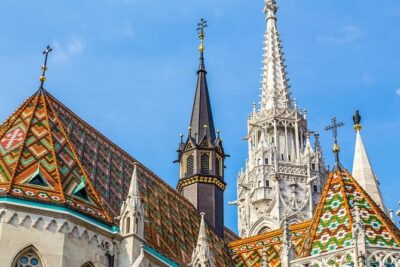
The tour includes a stop for the Church of the Assumption of the Buda Castle, often (incorrectly) labeled Matthias Church. The guide sets you straight on the official name and also points out its original connection to a German-speaking community. On Castle Hill, the church’s story is part religious, part cultural, and part political.
You do not get the interior of the church with this tour. If you want to go inside, you can plan that as an add-on after the walk.
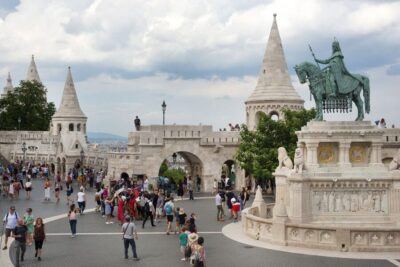
Later, you reach Fisherman’s Bastion, one of Budapest’s most recognizable landmarks. From the main level, you’ll see the equestrian statue of King Saint Stephen, Hungary’s first Christian king. The statue is a visual shorthand for state origins, and the Bastion architecture makes that meaning look ceremonial.
Important limit: you will not enter the upper panoramic lookout terrace. That access requires a separate ticket not included in the tour price. I actually think this helps. It means your time stays focused on the medieval and early modern streets and sites, not just ticketed platforms and viewpoints.
Fortuna Street to Becsi Kapu Square: printers, inns, and a medieval meeting point
Fortuna Street feels modern today with restaurants, but the tour places it back into the Middle Ages. You’ll learn that the street was once home to aristocratic palaces and grand townhouses, and in the 1470s it hosted a milestone in Hungarian publishing.
A German-born printer, Andreas Hess, produced Hungary’s first printed book here, the Chronica Hungarorum. You also hear about the Red Hedgehog Inn (Vörös Sün), a legendary meeting point for travelers, merchants, and intellectuals for centuries.
Then you shift to Becsi Kapu Square, once both a marketplace and a main entrance to medieval Buda. It’s a short stop, but it matters because it grounds the story in social life. You get a sense of where different groups crossed paths, including Hungarian townsfolk and the local Jewish community, who came together for trade, talk, and worship.
If you want a “small-world” feeling in Budapest, this part delivers it. It’s not a museum. It’s a place where the everyday happens.
National Archives and the 1686 siege story: power leaves paperwork and bullet holes
At the National Archives of Hungary, the tour shows you a building designed in a Neo-Romanesque style meant to match the medieval feel of the Castle District. It can look older than it is, but the intent is clear: national memory made monumental.
This is where your “architecture as evidence” theme returns. The building is not just pretty stonework. It houses documents spanning Hungary’s written past. Standing there, you get a sense of how empires and states preserve identity through records, not just statues.
Then comes the Siege of Buda in 1686, told along the outer castle walls with a memorial near where the walls were first breached by Christian allied forces. You also learn about the fall in battle of the Ottoman Pasha of Buda. The memorial honors multinational Christian soldiers who fought and died during the liberation of the city.
This stop can feel solemn, and that’s good. It keeps the walk honest. The Castle Hill story is not just architecture and aesthetics. It’s conflict, change, and survival.
Medieval Jewish quarter: excavations, worship spaces, and what is included
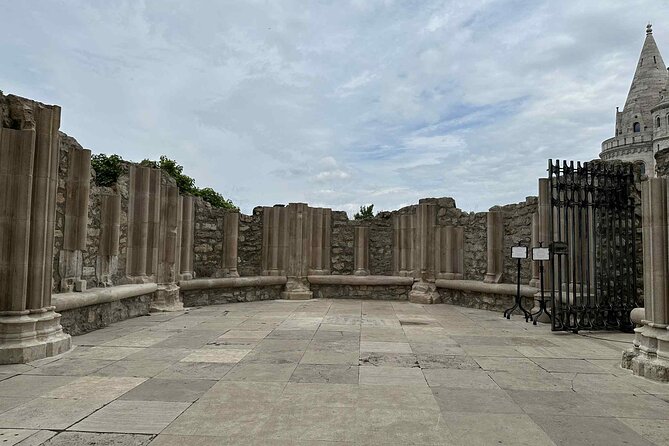
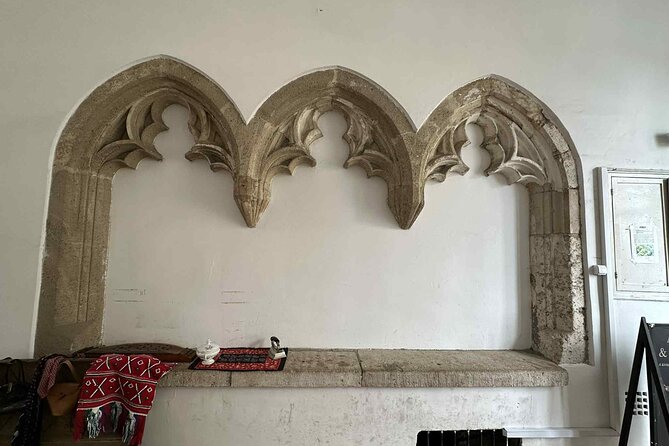
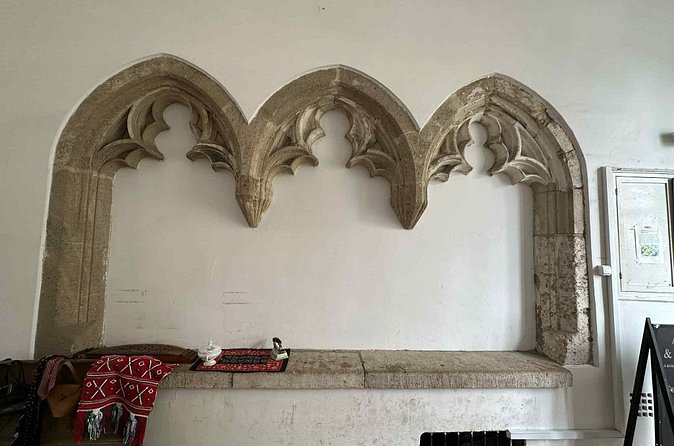
This is one of the most meaningful parts of the tour. You enter the medieval Jewish quarter of Buda and pause at the site of the former Gothic synagogue. Nearby, you step into the excavated medieval Jewish prayer house.
This prayer house is included, and it’s one of the rare times a walking tour gives you a covered interior experience. It’s modest in size, but the meaning is big: you’re seeing religious architecture that survived as archaeological evidence.
Two practical constraints: the prayer house is closed on Saturday and Monday, and entry is included only for that specific component. If your dates land on those days, you may need to adjust expectations.
The tour also keeps the mood quiet. This is not a loud photo-stop. It’s a place to let the history sit.
Reused medieval walls and the Dominican ruins near the Hilton
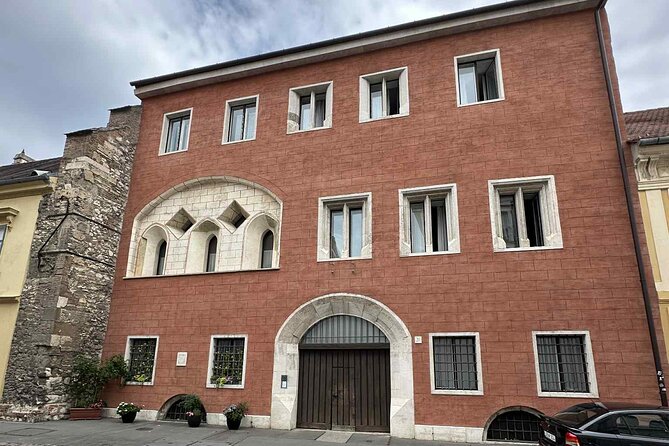
After that, you move into the story of reuse. On Táncsics Mihály utca, you encounter examples of medieval ruins that were not simply demolished. Instead, older Gothic walls and cellars were incorporated into later Baroque and residential buildings.
Look for the layered feel. You’re basically seeing centuries of construction thinking in one glance: what survived got folded into what came later. The tour frames this as post-Ottoman Buda rebuilding atop medieval foundations, both literally and symbolically.
Then you visit Dominikánus Udvar, the remains of the Dominican monastery of Saint Nicholas. The tour connects this site to Friar Julianus and his 13th-century journey. Again, it’s not just ruins for looks. It’s a location tied to a story with names and purpose.
Here’s the twist that makes the stop memorable. When the Hilton Hotel was constructed in the 20th century, the monastery ruins were dramatically reinterpreted within the new complex. It’s controversial, and the tour does not gloss over the tension between heritage and progress.
This part is a good reminder: the Castle District isn’t frozen in a medieval postcard. It’s a living urban environment that keeps negotiating what to preserve.
Price, group size, and what you truly get for $43.25
At $43.25 per person and about 3 hours 30 minutes, this tour is priced for real value if you care about context. The big reason is the balance between outdoor walking and included access. The included entrance fee is specifically for the Jewish praying house, and that is a major cultural stop.
You also get an official English-speaking guide, and the group size max is 12 travelers. That smaller cap matters in a history-heavy tour. You’re more likely to get answers to questions and you can hear explanations clearly.
I also like that it uses a mobile ticket. In a place like Budapest, where you might be juggling trams and timing, that reduces hassle.
One more practical consideration: the tour requires good weather. If the forecast looks rough, expect operators to adjust. Rain plus cobblestones plus time in the Castle District is not a fun combo.
The kind of guide you want: what the best feedback says
The standout in the feedback I’m taking to heart is the guide quality. Máté, in particular, comes up repeatedly as someone who connects history with architecture, with a passion that makes the details feel important. People also note he answers questions and uses visual aids, like lots of pictures on an iPad, to show what buildings might have looked like in earlier centuries.
If you’re the type who likes to ask why something was built the way it was, this tour style tends to work well. It’s not just a lecture. You get explanation plus the chance to point at what you’re seeing.
And yes, that matters on a cold December night. A long walk can feel like punishment if the pacing is wrong. The best versions of this tour keep energy high and make the walk feel like you’re moving through a story.
Who should book this Buda Castle District walking tour
This is a great fit if you:
- want architecture and history connected to real streets, courtyards, and walls
- like religious and multicultural layers, not just royal monuments
- enjoy a small group (max 12) and a guide who answers questions
It’s less ideal if you:
- need accessibility support, since it is not suitable for limited mobility
- are traveling with kids under 10, since children under 10 are not permitted
- hate walking in uneven stone areas, since it’s still a long Castle District route
Should you book this Buda Castle Tour?
If you’re choosing between a quick highlights loop and a deeper architectural walk, I’d pick this one. It covers the Royal Palace area, medieval streets like Tárnok Street and Úri Street, and the quieter but powerful stops like the medieval Jewish prayer house. You also get the 1686 siege memorial context, which most standard sightseeing passes over.
The limits are clear and reasonable: you’re not doing the Royal Palace interior, you’re not entering Matthias Church interior, and you’re not buying tickets for the Fisherman’s Bastion upper terrace. If you want those interiors too, you’ll need to plan them separately. But if your goal is to understand Buda Castle Hill in one smart, guided circuit, this walk is a strong use of time.
FAQ
What is the duration of the Buda Castle Tour?
The tour lasts about 3 hours 30 minutes.
How much does the tour cost?
The price is $43.25 per person.
Is the tour offered in English?
Yes, it is offered in English.
Is the Royal Palace interior included?
No. Admission to the interior of the Royal Palace is not included, but you can visit independently after the tour.
Is Matthias Church interior admission included?
No. Admission to the interior of Matthias Church is not included.
Is Fisherman’s Bastion upper terrace access included?
No. Access to the upper panoramic terrace of Fisherman’s Bastion is not included. The tour also notes you will not enter that upper terrace.
What is included with the Jewish quarter stops?
Entrance fee to the Jewish Praying House is included. It is closed on Saturday and Monday.
Where does the tour start and end?
It starts at the Statue of Prince Eugene of Savoy and ends at Matthias Church, right beside Szentháromság Square.
More History Tours in Budapest
- Budapest: Historic Cruise with Welcome Drink
★ 4.7 · 6,512 reviews - Budapest Historical Sightseeing – Free Walking Tour
★ 5.0 · 1,302 reviews - Buda Castle District Dark History, Legends and Vampire Night Tour
★ 4.5 · 1,240 reviews - BloodThirsty Hungary: Walking tour & Dark Historical Stories
★ 4.9 · 633 reviews
Latest to land in Budapest
- Visegrád Hike & Castle Tour with Ferry from Budapest★ 4.6 · 3 reviews
- Budapest: Vacation Photographer to collect great memories★ 5.0 · 49 reviews
- Trash Art Museum: Hungary’s First Scrap Metal Exhibition★ 4.3 · 72 reviews
- True Crime Walking Tour in the Buda Castle district★ 5.0 · 26 reviews
- Budapest: 3-Hour Trabant Sightseeing Tour★ 4.7 · 28 reviews
- Audio visual multi-sensory chefs journey dinner experience★ 5.0 · 3 reviews
- Private Szentendre and Vac Tour from Budapest with Transport★ 5.0 · 3 reviews
- Wine Tasting in the Countryside from Budapest★ 5.0 · 14 reviews
Buda Castle District Tours, compared.
Buda Castle District Vampires and Myths Night Tour
Read our review →

Buda Castle District Dark History, Legends and Vampire Night Tour
Read our review →
Buda Castle District Walking Tour with a Historian
Read our review →
Browse the lists this tour appears in